
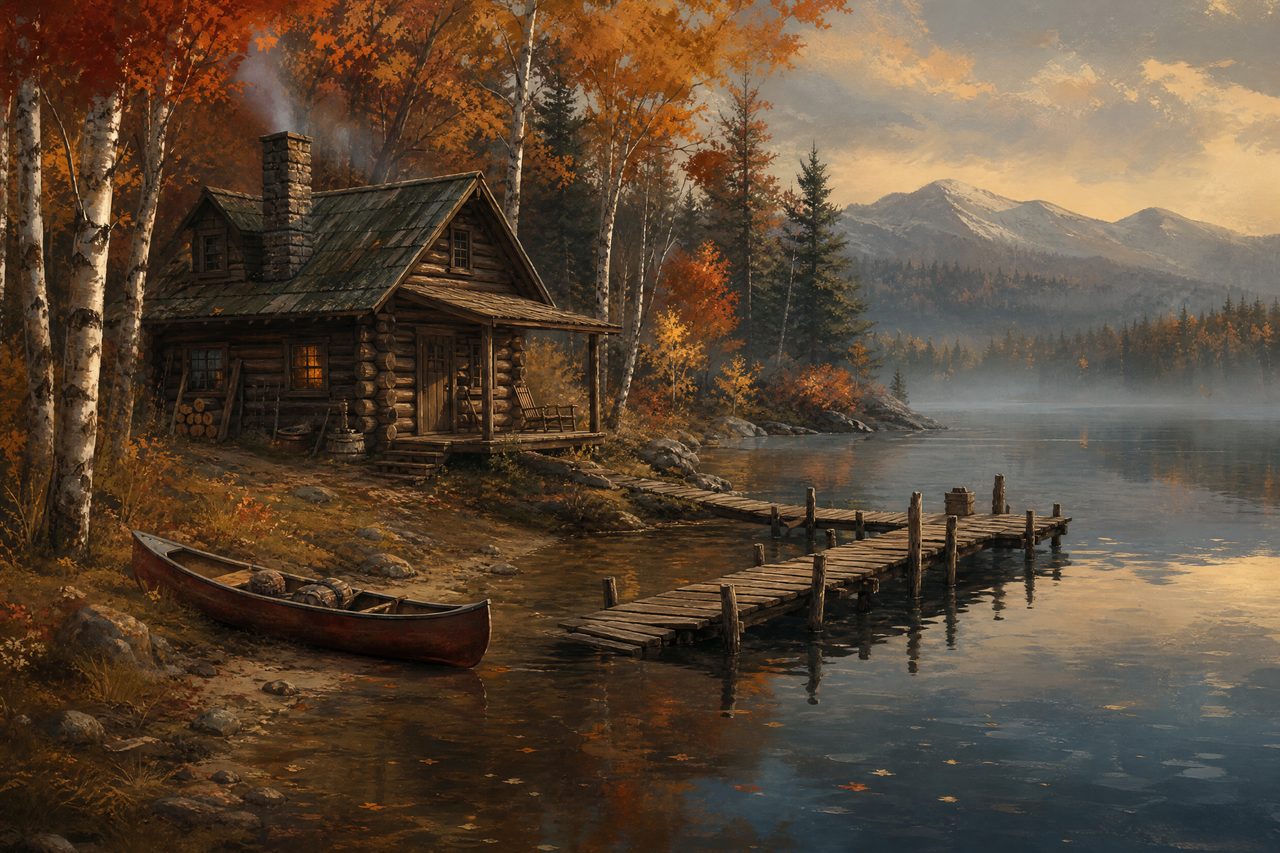
I want to be clear that Birch Lake is the best-made game in this notebook. The water is extraordinary. The autumn light changes across a day in a way that made me stop playing several times just to watch it. Cutting and stacking timber has a weight and rhythm that nothing else here approaches, and the cabin I built is the only structure in fourteen notebooks that I would describe as beautiful.
It also produced the second-shortest log among the games I played seriously, and the reason is that it gave me everything.
What supplying everything looks like
Timber is abundant and comes in usable lengths. Fish are plentiful and predictable. Weather is atmospheric rather than dangerous. The cabin can be built from a small set of parts that fit together correctly on the first attempt, and the game shows you where they go.
Nothing in twenty-nine hours went wrong. Not once. There is no failure state in Birch Lake beyond mild cold, and the notebook for hours nineteen to twenty-nine contains almost no entries at all, because nothing happened worth writing down.
| Hours | What the notebook records | Problems encountered |
|---|---|---|
| 0 – 3 | Arriving, exploring the shore, first camp | 1 — finding a site |
| 3 – 11 | Timber, foundation, walls | 1 — a slope I misjudged |
| 11 – 19 | Roof, chimney, jetty, canoe | 0 |
| 19 – 29 | Fishing, watching the light, paddling | 0 |
Two problems in twenty-nine hours. Plateau Holding generated something worth writing about roughly every ninety minutes for ninety-six hours, and almost all of it came from things being difficult.
The first goal took two hours forty
Late by the standards of this notebook, where the median is an hour and eight minutes. It took that long because the wilderness does not present a problem; it presents a view.
In Quarry Gap the gap is visible in the first minute and the goal writes itself. Here I wandered for two and a half hours enjoying myself enormously before deciding — arbitrarily, from a list of equally pleasant options — that I would build a cabin on the north shore. Nothing in the terrain argued for the north shore. Nothing argued against it either.
A sandbox needs friction to produce a goal. Beauty produces appreciation, and appreciation is not an activity you can sustain for ninety hours.
Where the twenty-six per cent went
The invented figure counts the memorable events that originated with me rather than the game. In Birch Lake, only eight of thirty-one such events did: choosing the shore, misjudging a slope and having to re-cut a beam, deciding the jetty should be longer than it needed to be, and a handful of self-imposed rules about only using timber from within sight of the cabin.
Notice what those have in common. Every one is a restriction I imposed to create a difficulty the game would not supply. That is the clearest evidence in this file for the claim Ledger B now makes: players do not invent because a game is generous, they invent because a game leaves gaps, and Birch Lake has very few.
Is this a criticism?
Only within this notebook's terms. If what you want is twenty-nine hours in an autumn wilderness with a cabin at the end of it, Birch Lake delivers that with more craft than anything else here, and twenty-nine hours is not a small amount of time.
But this notebook is about open-ended games, and open-endedness is a promise of indefinite continuation. Birch Lake is not open-ended; it is a long, gentle, beautifully-observed activity with a natural conclusion around hour nineteen, followed by ten hours of me not wanting to admit it had finished.
The closure reason in the index reads nothing left to want rather than bored, and that distinction matters. I was not bored at hour twenty-nine. I was content, which in a game with no ending amounts to the same thing.
The one thing I would change
Make the timber irregular. That is all. If beams came in the lengths the trees actually offered rather than in usable units, every join would become a decision, the cabin would be slightly wrong in ways particular to my lake, and I suspect this log would read forty hours instead of twenty-nine.
That is a guess, and it is the kind of guess this notebook is not equipped to test. But three of the four longest logs in the file involve materials that resist being used, and the shortest involve materials that cooperate.
Entry summary
The most beautifully made game in this notebook, and the one that left least to do. Abundant cooperative materials, no failure state, and two recorded problems across twenty-nine hours. The invented figure of twenty-six per cent consists almost entirely of restrictions I imposed to manufacture difficulty the game would not supply. Closed content rather than bored, which in an open-ended game is the same outcome.