
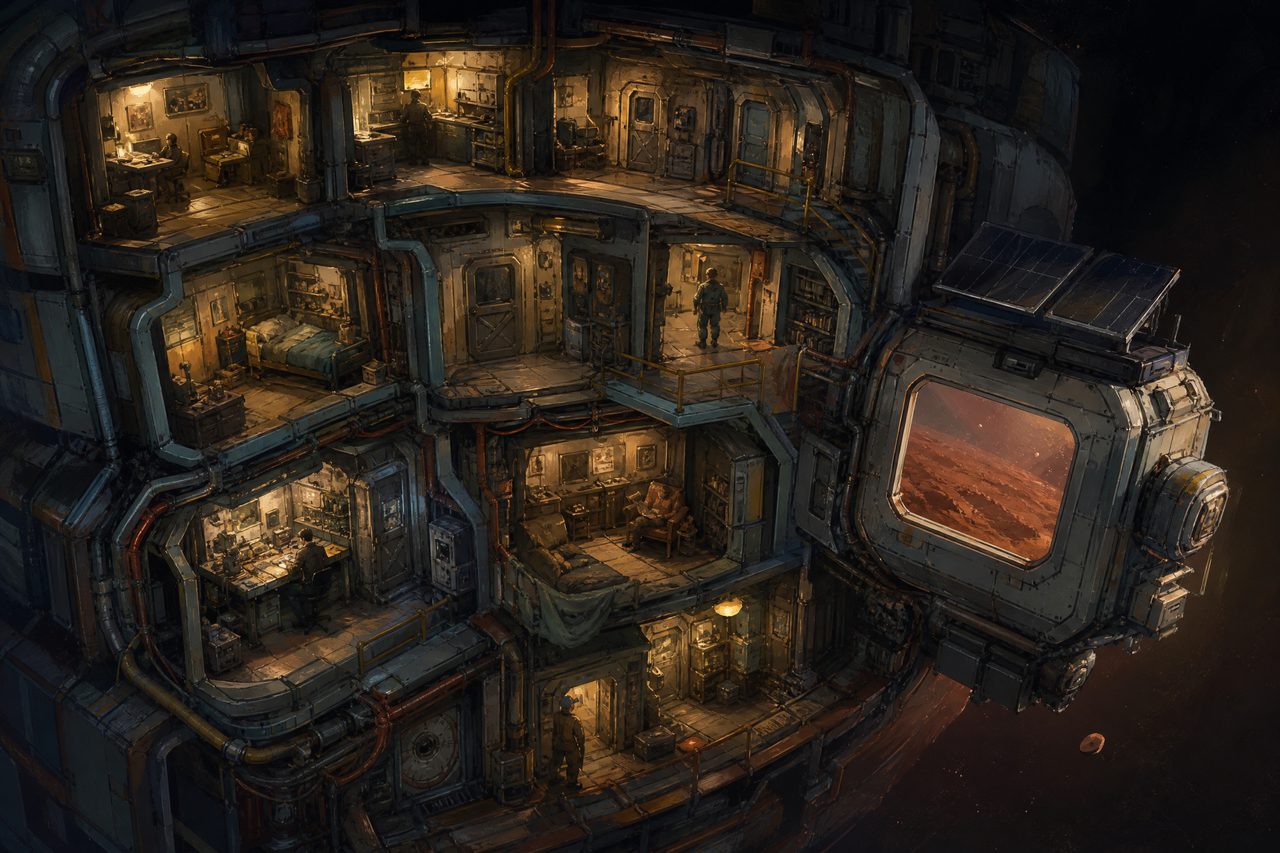
Spiral Station is not the game's name for itself. It is what I called the save file at hour twelve, when I noticed that the corridor from the original habitat had curved right around and nearly met itself, and that this had happened without any decision on my part.
The game is a modular station builder: pressurised sections, power, heat, air, and a crew who need all four maintained. It has an undo function, refunds most of a module's cost when you remove it, and imposes no penalty at all for tearing down and rebuilding. It is, by the standards of this notebook, extremely forgiving.
And in thirty-eight hours I demolished nothing. Not one module.
What the game supplies
A genuinely good systems layer. Heat is the interesting one: modules generate it, radiators shed it, and the geometry of your station determines whether heat can get from where it is made to where it can leave. A compact station is efficient and cramped; a sprawling one has thermal problems in the middle.
That single relationship carries the first twenty hours. Every new module is a heat decision as much as a space decision, and because heat propagates through adjacency, where you put something matters far more than what it is.
| Hours | Modules added | Modules removed | Dominant problem |
|---|---|---|---|
| 0 – 6 | 9 | 0 | Learning heat and power |
| 6 – 15 | 14 | 0 | Crew capacity |
| 15 – 26 | 17 | 0 | Heat in the interior |
| 26 – 38 | 11 | 0 | Walking distances |
The habit, examined
By hour twenty-six the station had a clear structural problem: the oldest sections were in the middle, they were the smallest, and they were where all the heat accumulated. The correct move was obvious — remove four early modules, rebuild them larger with a radiator corridor through the centre. The game would have refunded most of the cost and taken maybe twenty minutes.
Instead I built a bypass corridor around the outside, which is the decision that produced the spiral. Then, twelve hours later, a second bypass around that.
The notebook has three attempts at explaining this. The first is sunk cost, which is probably part of it. The second is that the early modules were where the crew's first quarters were, and removing them felt like erasing the station's history — which sounds sentimental but shows up repeatedly in this file. The third, and I think the true one, is that adding is a decision about the future while demolishing is an admission about the past, and the game made the first trivially easy.
Cheap demolition does not produce revision. It removes the cost of revision without supplying any reason to revise, and a sandbox player will always prefer building something new to admitting something old was wrong.
That connects directly to Plateau Holding, where demolition is expensive and I also never revised — and produced ninety-six hours instead of thirty-eight. The variable that matters is apparently not the cost of revision at all.
Why it closed at thirty-eight hours
Boredom, and of a specific kind: the station's problems became repetitive rather than harder. After the second bypass corridor, every new requirement had the same solution — attach it further out, run a line back. The heat system, which had been the whole interest of the early game, was effectively defeated by having enough exterior surface.
A sandbox needs its problems to change shape as it grows. This one's problems grew in quantity and stayed identical in kind, so hours twenty-six to thirty-eight are the same session repeated eleven times, and the log gets visibly shorter each night.
What it does better than anything else here
Legible interdependence. When something goes wrong on this station you can trace it — a module is too hot because it is four sections from a radiator, and you can see the four sections. Compare the hidden gradients in Plateau Holding or the uninspectable banks in Lowfield, both of which hide the property that matters most.
The crew are also handled with unusual economy. They have no dialogue and almost no characterisation, but they walk, and watching somebody walk the full length of the spiral to reach a workshop communicates the station's failure more effectively than any statistic would.
What the entry cannot settle
Whether the spiral is the game's fault or mine. A design that offered any reason to consolidate — a maintenance cost that scaled with total surface, say, or a structural limit on station diameter — would probably have forced a rebuild at hour twenty-six and produced a longer notebook.
But it is equally possible that I am simply a player who does not demolish things, in which case no amount of design would have helped and this entry is a description of me. Ledger B notes the same tendency across three other builders in the file, which is suggestive without being conclusive.
Entry summary
An excellent heat-and-adjacency system that becomes trivial once the station has enough exterior surface, and the clearest record in this notebook of a player refusing to revise despite every incentive to do so. Legible interdependence, effective wordless crew, and a late game where every problem has the same answer. Fifty-one modules added, none removed, closed bored at thirty-eight hours.