
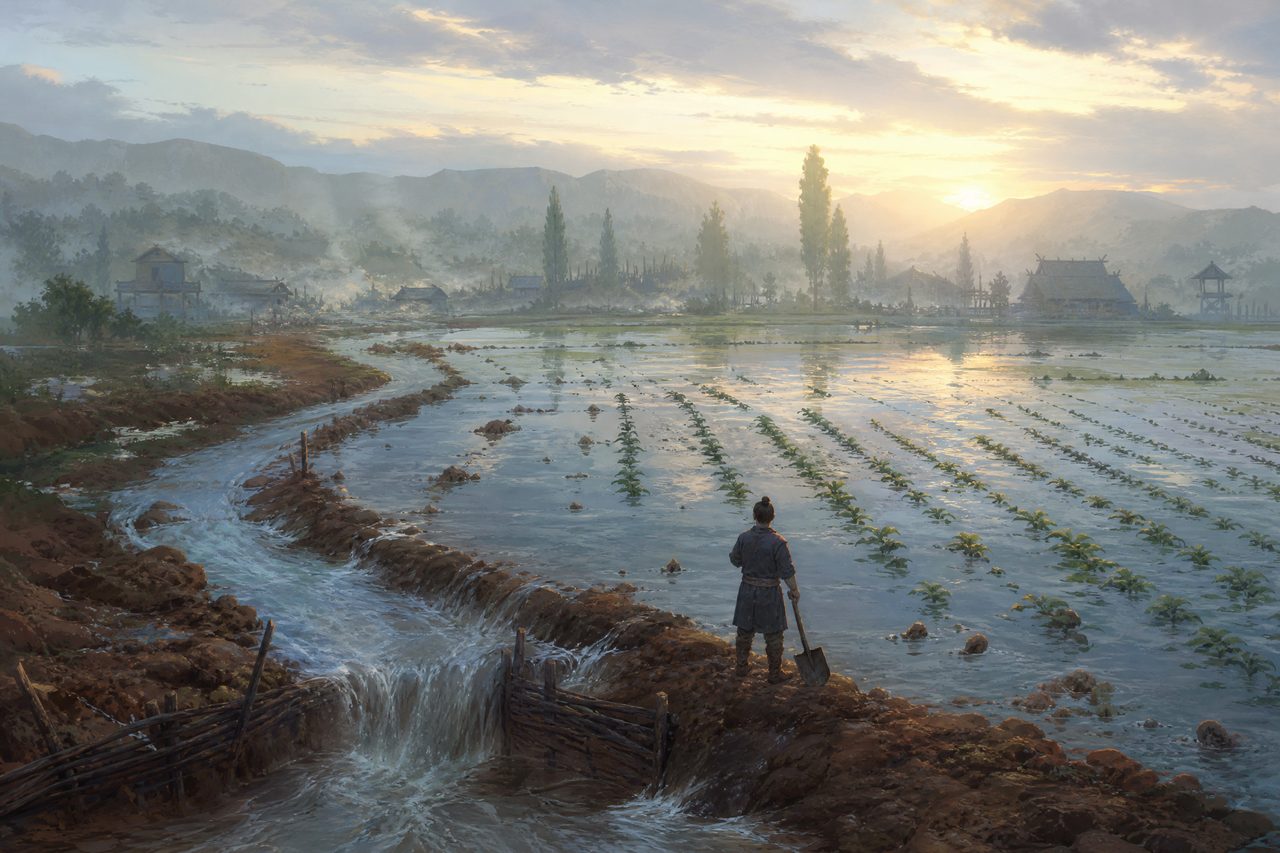
The last line in this notebook was written while the water was still spreading: bank gone at the elbow, whole lower terrace under, this is finished. I sat and watched for a few minutes, checked whether there was any way back, established that there was not, and closed the log.
Lowfield is a farming sandbox built on a river valley with a snow-fed watercourse and a seasonal melt. You dig channels, you grade terraces, you plant according to what the soil will carry, and the whole thing runs on a water model that does not care about your intentions. It has no objectives and no ending, which puts it in this notebook, and it has one permanent failure state, which makes it the most interesting entry here.
What forty-four hours looked like
Quiet. The first goal at one hour five was plant the middle terrace before the thaw, arrived at by reading the soil colour and the slope. From there the game proceeds at the pace of seasons: prepare, plant, wait, harvest, adjust.
What it supplies is unusually high for this notebook at fifty-one per cent, and the reason is the soil model. Different terraces hold water differently, and the game communicates that through appearance rather than numbers — colour, cracking, how quickly a dug trench holds. Learning to read it is a genuine body of knowledge that the game authored, not something I invented.
| Hours | Seasons | What the notebook records |
|---|---|---|
| 0 – 6 | 1 | Reading soil, first channel, first planting |
| 6 – 18 | 3 | Terracing upward, learning the melt |
| 18 – 31 | 4 | Lower terrace, the elbow channel, surplus |
| 31 – 43 | 3 | Orchard on the high ground, quiet years |
| 43 – 44 | 1 | The melt, the bank, the end |
The elbow
At around hour twenty-four I cut a sharp corner into a channel to route water around a rock shelf rather than through the labour of removing it. The turn was tight. Water hitting the outside of a tight turn scours the bank, which the game models, and over nineteen further hours of play it quietly ate that bank thinner while I farmed above it.
The information was available. There is a visible difference in the bank colour where scouring happens, and I have a note from hour thirty-one that reads elbow looks dark, check it. I did not check it. Twelve hours later the spring melt arrived carrying more volume than any previous season and the thinned bank failed.
The flood was not bad luck. It was a decision made at hour twenty-four, a warning ignored at hour thirty-one, and a season that was slightly heavier than usual. All three are in the log, in my own handwriting, before the thing happened.
Why this is good
Because it is the only game in fourteen where anything I did could genuinely be lost, and the notebook is far more attentive as a result.
Read the session notes for hours eighteen to thirty-one and they are full of measurements — gradients paced out, bank widths compared, planting delayed to watch a melt. Then read the notes for Quarry Gap, where a failed structure costs one keypress, and they are a list of attempts. Same person, same notebook, entirely different quality of attention, and the difference is that one game could take something away.
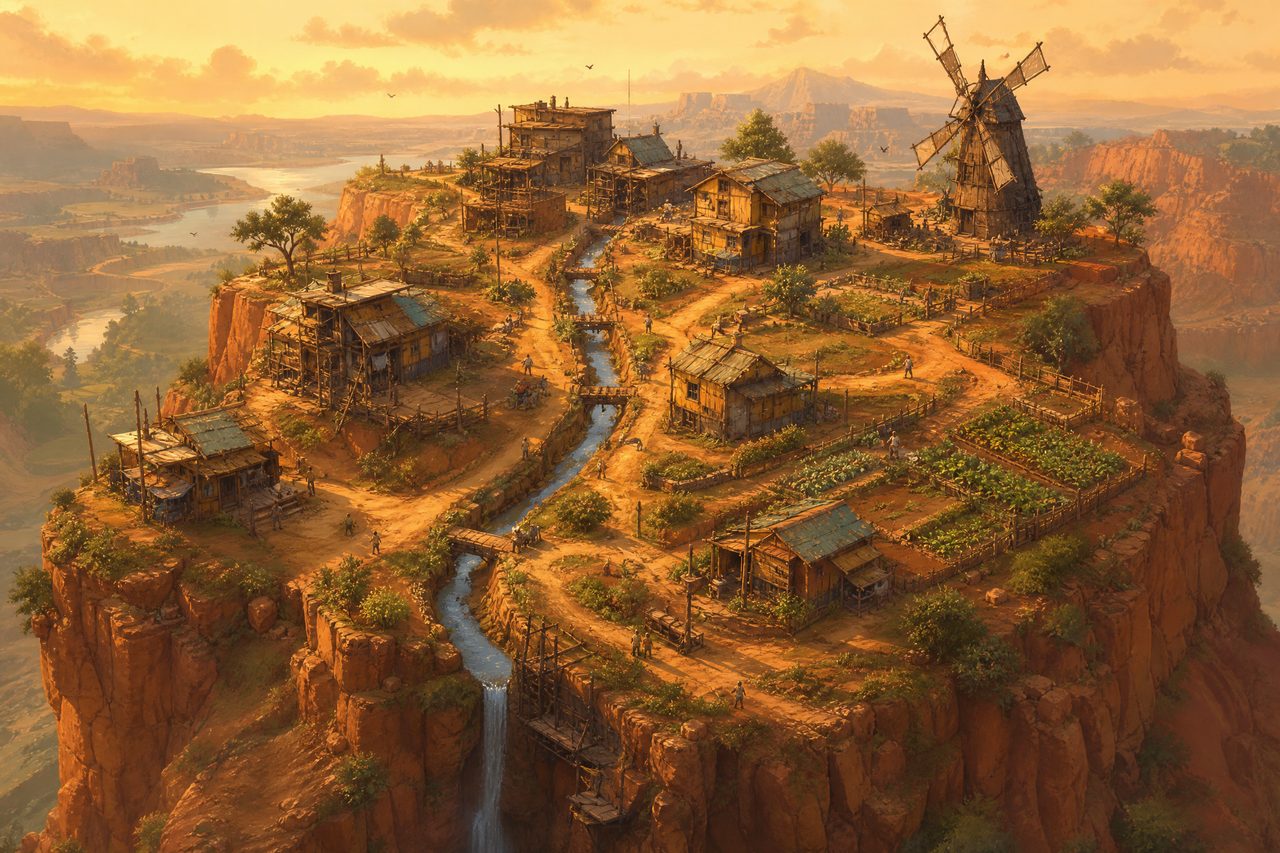
Plateau Holding sits between the two: expensive to revise but never fatal, which produced the longest log in the file. Lowfield is harsher and produced a shorter one, so this entry is not an argument that permanence is simply better. It is an argument that permanence is what made forty-four hours feel like a hundred.
Where it is genuinely weak
There is no way to inspect a bank's condition deliberately. The colour cue exists but there is no measurement, no cross-section view, no way to ask the game how thin something has become. For a game whose entire failure state depends on that one property, this is close to negligent, and it is the same criticism this notebook makes of Plateau Holding's hidden gradients.
The seasons are also too similar until they are not. Four melts in a row arrived at comparable volume, which taught me that melts are predictable, and then the fifth was heavier. That is realistic and it is also the only variance in forty-four hours, so the lesson the game teaches for most of its length is wrong.
And the recovery path is absent rather than difficult. A ruined lower terrace could plausibly be rehabilitated over several seasons with enough labour; instead the soil is simply spoiled and the land is dead. A hard road back would have been better than none, and would probably have added twenty hours to this log.
Whether I would start again
No, and the log explains why in a way I did not expect. By hour forty-three the valley had a history — a good terrace, a bad terrace, an orchard planted late, the elbow I never fixed. Starting a new valley means starting a new history, and the appeal of this game was never the farming. It was that particular place.
That is also why the closure is filed as a consequence rather than as boredom. I did not stop wanting to play Lowfield. I stopped being able to play the Lowfield I had.
Entry summary
The most attentive notebook in the file, produced by the only game here that can take something away permanently. An excellent soil and water model communicated visually, undermined by having no way to inspect the one property that kills you, and by four identical seasons that teach the wrong lesson before the fifth. Closed at forty-four hours by a bank failure traceable to a decision twenty hours earlier and a warning I wrote down and ignored.