
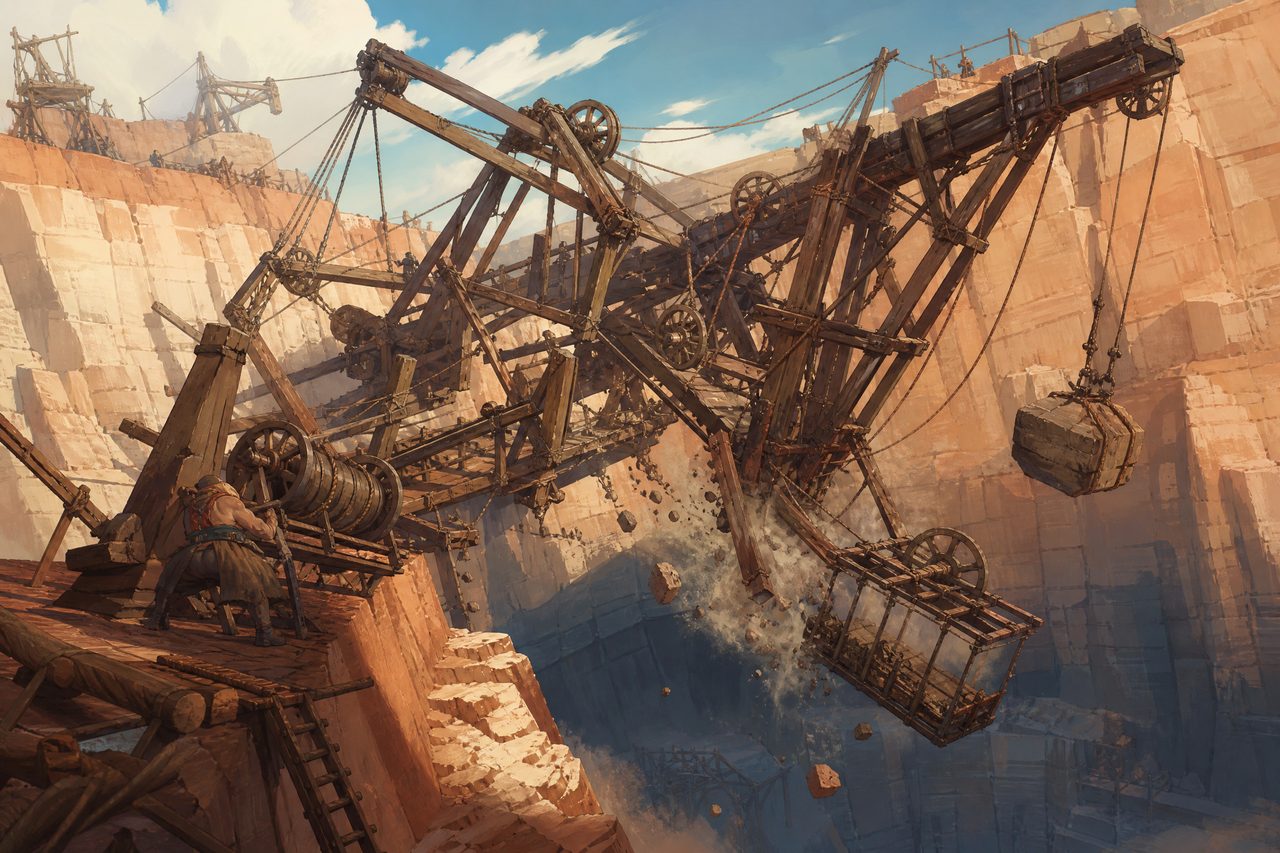
Twelve minutes into Quarry Gap I had set myself a goal: get a stone block from one side of the pit to the other. Nobody suggested it. The game had shown me a quarry, a gap, some timber and a working rope simulation, and the objective assembled itself immediately.
Fifty-two hours later I had built forty-one machines and closed the notebook, because the game had nothing left to show me. Eighty-one per cent of everything memorable in that log was mine rather than the game's — the highest figure in the notebook by a wide margin — and I now read that number as a warning rather than a boast.
What the game actually supplies
Timber, rope, chain, a counterweight, stone blocks of three sizes, and a physics solver that is genuinely excellent. Beams flex before they break. Rope stretches under load and stays stretched. A pulley reduces effort in a way that matches what you would expect if you had ever used one.
There is no campaign, no tutorial past the controls, and no objectives at all. The quarry has four faces, a pit, and a gap. That is the entire content.
The solver deserves particular credit for one thing: failure is legible. When a structure collapses you can see why, because the piece that failed visibly fails first and the rest follows. Two other physics sandboxes in this notebook simply explode into components, and both produced shorter logs.
| Hours | Machines built | What was still unknown |
|---|---|---|
| 0 – 8 | 6 | Everything. Bracing, load, rope behaviour |
| 8 – 22 | 14 | Counterweight timing, chain vs rope |
| 22 – 38 | 13 | Efficiency only |
| 38 – 52 | 8 | Nothing |
The problem with eighty-one per cent
This notebook began with an unexamined assumption: that a high invented figure indicates a generous sandbox. Quarry Gap is where that broke.
Eighty-one per cent invented means the game contributed almost nothing to what I remember. That is a description of a very good toy, and a toy is exhausted when you have understood it. By hour thirty-eight I could predict what any arrangement of beams would do before building it, and the moment a physics sandbox becomes predictable it stops producing anything.
A high invented figure is not generosity. It measures how much the game left to you, and a game that leaves everything to you will be finished the moment you stop being surprised.
Compare Plateau Holding at thirty-eight per cent supplied and ninety-six hours logged. That game kept introducing conditions — seasons, silt, labour scarcity — that changed what my own inventions meant. Quarry Gap has one set of physical laws and no conditions at all, so my inventions accumulated into competence rather than into a place.
This is the reasoning behind Ledger B, and it is why that ledger now argues the best-remembered games sit in the middle of the range rather than at the top of it.
What is genuinely excellent
The twelve-minute first goal is the fastest in the notebook and it is not an accident. The quarry is arranged so that a gap is the first thing you see and the timber pile is the second. Nothing is explained, and nothing needs to be.
The materials also behave differently enough to matter. Rope stretches and stays stretched; chain does not stretch but is heavy enough to change a counterweight's behaviour; timber flexes and takes permanent set. Choosing between them is a real decision for the first twenty hours.
What it lacks
Persistence with consequences. Machines can be dismantled at no cost and rebuilt instantly, so nothing I built ever constrained anything I built later. Every one of the forty-one machines existed in isolation.
That is defensible for a physics toy and it is precisely why the log is fifty-two hours rather than ninety. In Lowfield a single bad decision about water ended the game permanently; in Quarry Gap the worst outcome of any decision is that you press a key and try again.
There is also no weather, no load from anything other than gravity, and no material degradation. A structure that stands is finished forever, which means the quarry contains no maintenance and therefore no relationship with anything you make.
Why the notebook closed
Exhaustion, and of an unusually clean kind. The last four sessions each ended earlier than the one before, and the final log entry reads: built the gap crane again, better, felt nothing.
Nothing broke, no patch interfered, and I was not bored of the activity — I was finished understanding it. Three notebooks in this file closed this way and all three were physics sandboxes, which is either a property of the genre or a property of how I play them. Ledger B is where that question sits, unresolved.
Entry summary
An outstanding physics solver with legible failure, the fastest first goal in the notebook at twelve minutes, and the highest invented figure at eighty-one per cent. It closed after fifty-two hours because nothing persists, nothing degrades and nothing constrains anything else, so understanding the physics finishes the game. The entry that convinced us a high invented figure is a limit rather than a virtue.