
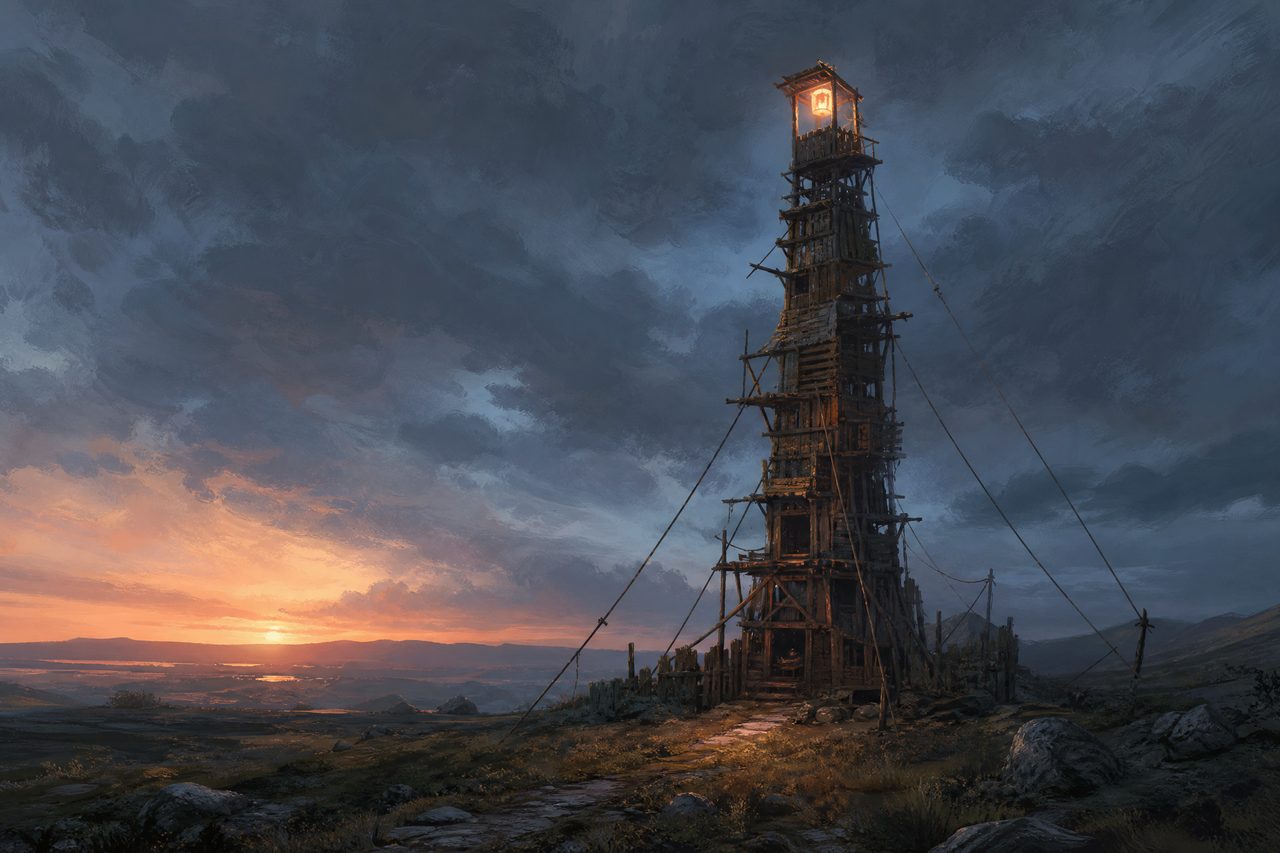
The session log for hour twenty-nine contains one line, written at the time: have enough food for three winters, don't know what to do now. Everything interesting about this game happens after that sentence.
Moor Tower is a survival sandbox on a single large moor — peat, gorse, standing water, weather that will kill you in the first week and then never again once you understand it. The survival layer is well made and finite. By hour twenty-five I had a turf shelter, a smoker, a peat supply and a reliable food surplus, and the game had run out of ways to threaten me.
At which point I started building upward, for no reason that the game recognises, and did not stop for forty-two hours.
The competent part
Credit where it is due: the first twenty-nine hours are a good survival game. Warmth is the primary threat rather than food, which is unusual and correct for the setting. Peat must be cut and then dried, so fuel is a two-stage problem with a delay in the middle, and that delay is what makes the first winter frightening.
Water is everywhere and almost all of it is bad. Learning which pools are drinkable is done by observation — reeds and moving water are safe, still water with an oily surface is not — and the game never states this anywhere. Three notebooks in this file learned it the same way, by getting ill twice.
| Hours | What the notebook records | Threat level |
|---|---|---|
| 0 – 3 | Exploring, first shelter, first illness | High |
| 3 – 12 | Peat cutting, drying rack, first winter | High |
| 12 – 25 | Smoker, food surplus, second winter | Moderate |
| 25 – 29 | Nothing. Genuinely nothing. | None |
| 29 – 71 | The tower | None |
Why a pointless tower
Because the building system is better than the survival system and the game does not know it.
Timber on the moor is scarce and comes in irregular lengths from driftwood and old fence posts, so you cannot build modularly. Every join is a specific piece meeting another specific piece, and the physics is honest enough that a tall thin structure will actually fall over unless you brace it. Guy-ropes work. Counterweights work. Nothing in the interface suggests any of this is intended.
The tower was not a goal the game offered. It was the only thing left that could still fail, and a sandbox that has nothing left to fail at is over.
That is the finding this entry contributes to the notebook. Once the survival layer was solved, I did not stop playing; I went looking for a new source of failure and found one in the physics. Games that offer no such reservoir close at exactly the point Moor Tower reached at hour twenty-nine, and four notebooks in this file did.
What the game gets wrong about its own strength
Nothing in Moor Tower acknowledges the tower. There is no height measurement, no stability readout, no record of what you have built. At eleven storeys I was estimating stability by nudging beams and watching for sway, which was enjoyable and also faintly absurd given that the simulation knows the answer precisely.
There is also no way to salvage cleanly. Dismantling returns roughly half the timber, which on a moor with almost no trees means revision is expensive — and unlike Plateau Holding, where expensive mistakes produced a story, here it simply meant the lower six storeys are worse than the upper five and always will be.

How the notebook closed
A patch at hour seventy-one changed how structural load is calculated. The stated intent was to stop players building unsupported overhangs. The effect on my save was that four storeys of the tower were now unstable, and the game resolved that by collapsing them the moment the world loaded.
I rebuilt one storey, looked at the pile of splintered timber that used to be the top of the thing, and closed the notebook. It is one of two closures in this file caused by a patch, and I do not think the studio did anything unreasonable — the old calculation was clearly wrong. But it is worth recording that in a game with no ending, a change to the physics is a change to your history.
What the entry cannot tell you is whether the tower would have held my attention beyond hour seventy-one anyway. The log for the last three sessions shows shorter and shorter play, so probably not for long. The patch ended something that was already slowing.
Entry summary
A competent survival game for twenty-nine hours and an accidental building game for forty-two more. Peat and warmth make an excellent early threat; the physics that keeps the game alive afterwards is undocumented and unacknowledged by its own interface. Closed by a patch that recalculated structural load and collapsed four storeys, at a point where the notebook was slowing anyway.