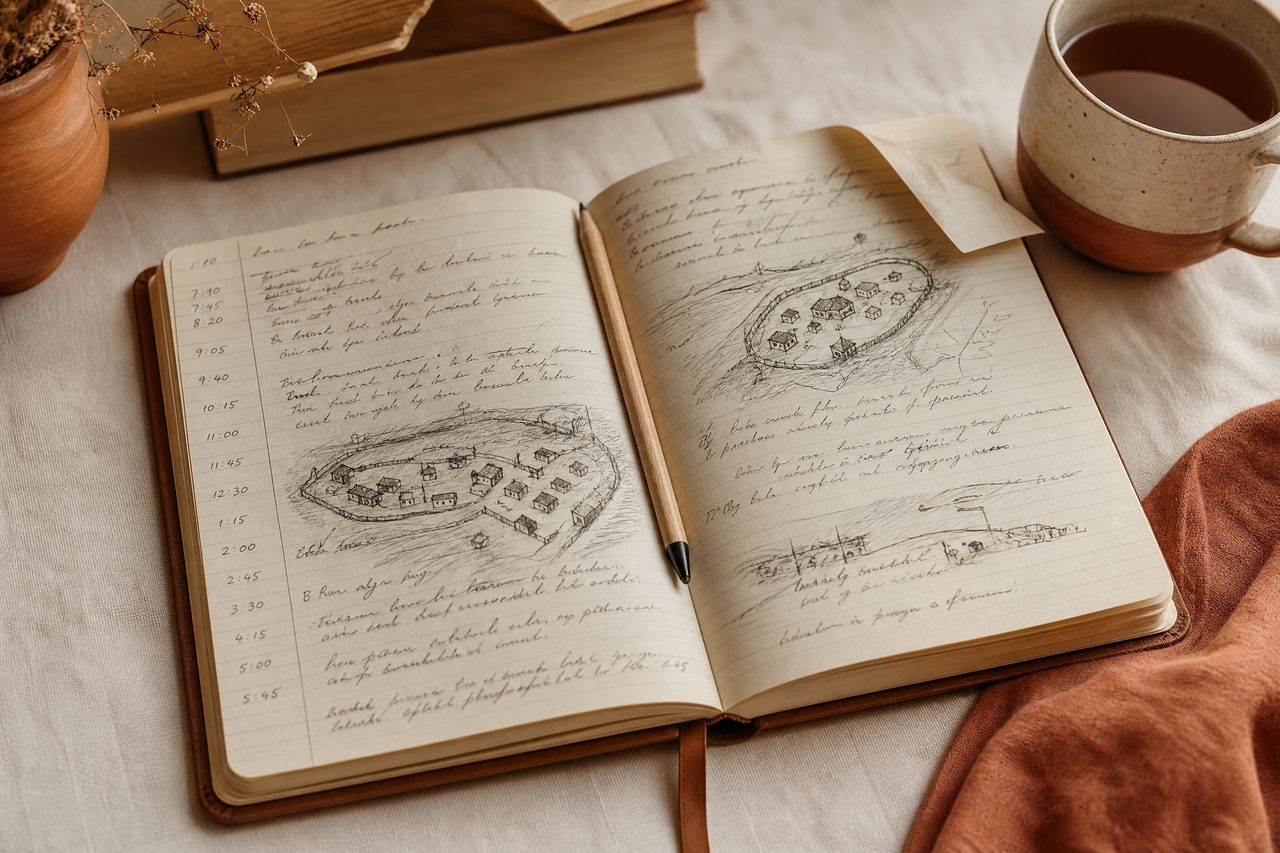
Both ledgers
Counts that only mean anything across many games at once
An individual entry describes one game. These two pages describe the shape of all fourteen, which is where the only genuinely useful findings in this notebook live.
Standing figures
What both ledgers currently say
Summarised here so the direction of the counts is visible without reading either page in full.
| Notebook | Hours | First goal | Invented | Materials |
|---|
| Plateau Holding | 96 | 0:40 | 62% | Resist |
| Moor Tower | 71 | 3:15 | 56% | Resist |
| Quarry Gap | 52 | 0:12 | 81% | Cooperate |
| Lowfield | 44 | 1:05 | 49% | Resist |
| Spiral Station | 38 | 0:55 | 54% | Cooperate |
| Birch Lake | 29 | 2:40 | 26% | Cooperate |
| Terrace Works | 34 | 0:50 | 58% | Resist |
| Salt Marsh | 27 | 4:00 | 39% | Resist |
| Cog And Beam | 23 | 0:20 | 77% | Cooperate |
| Orchard Row | 19 | 1:30 | 44% | Cooperate |
| Drift Habitat | 16 | 1:10 | 52% | Cooperate |
| Pine Hollow | 11 | 3:35 | 31% | Cooperate |
| Ridge Claim | 8 | 2:20 | 29% | Cooperate |
| Chalk Flats | 4 | 0:15 | 84% | Cooperate |
Read the last two columns together and the pattern both ledgers keep circling becomes visible: three of the four longest notebooks belong to games whose materials resist being used, and every notebook under twenty hours belongs to a game whose materials cooperate.
That is fourteen data points collected by one person, which is not evidence of anything general. It is, however, the reason the entries increasingly talk about friction rather than about freedom.