
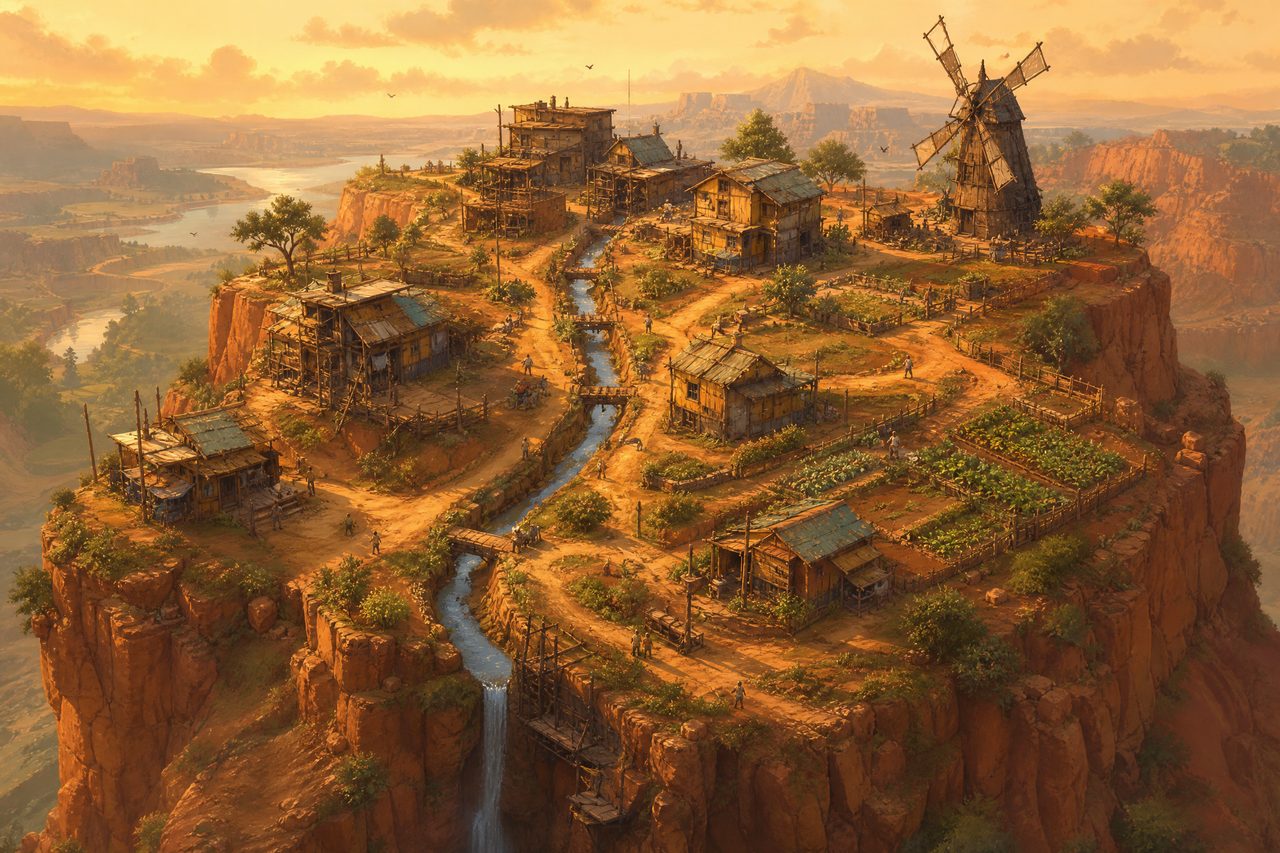
On the first afternoon I dug a channel from the spring on the high ground down to a patch of flat earth I had decided would be the fields. The line I chose was wrong. It ran along the contour instead of across it, which meant the water moved slowly, silted up constantly and needed clearing roughly every twenty minutes of play. Correcting it would have taken about half an hour.
Ninety-six hours later I had never corrected it. Every path in the settlement follows that channel. The houses stand where they do because they stand near it. Two of my three windmills exist to lift water back up a gradient that would not exist if I had simply dug the thing properly. The entire holding is a monument to a decision made in ignorance in the first forty minutes and then defended for four months.
That is the best sandbox game in this notebook, and the reason is precisely that.
What the game supplies
Less than you would expect. There is terrain with a water table, a set of crops with real requirements, weather that arrives on a seasonal cycle, and settlers who need feeding and will leave if they are not. There are no quests, no tech tree in the usual sense, no notifications telling you what to do next, and no score.
What it does have — and this is the whole design — is a simulation detailed enough that your mistakes persist. The silting in my channel is not a scripted nuisance. It is the consequence of a gradient below the threshold at which the water model moves sediment, and it would stop if I regraded the trench. The game never once told me that. It let me find out in hour nine by watching where the silt collected.
A sandbox is only as interesting as its mistakes are durable. Plateau Holding is built on the principle that you should be able to be wrong for ninety hours in a way that keeps mattering.
The first forty minutes
The log records a self-set goal at forty minutes: get water to the flat ground before the settlers arrive. Nothing asked for it. I had walked the terrain, noticed the spring, noticed the flat patch, and constructed the objective myself out of those two observations.
Forty minutes is fast for this notebook — the median is an hour and eight minutes — and it happened because the terrain reads clearly. Water is visibly above; flat earth is visibly below; the connection is obvious. A sandbox that takes four hours to produce a first goal usually does so because its materials are hard to read, not because it is deep.
The middle sixty hours
This is where most notebooks close and this one did not. From roughly hour twenty to hour eighty the game gave me nothing new at all. No new crops, no new buildings, no new terrain. What changed was the settlement, and what changed the settlement was accumulated consequence.
The channel silted, so I built a clearing rota. The rota needed labour, so the holding grew. Growth put houses further from the water, so I built the first windmill to lift it. The windmill needed timber from the lower slope, which put a path across the channel, which needed a bridge, which silted the channel further at that point.
| Hours | What occupied the notebook | Originated with |
|---|---|---|
| 0 – 6 | Reading terrain, digging the channel | Game |
| 6 – 20 | First crops, first settlers, first winter | Game |
| 20 – 44 | Silt rota, labour growth, first windmill | Us |
| 44 – 68 | Terracing, second windmill, bridge problem | Us |
| 68 – 88 | Deliberately rebuilding the oldest quarter | Us |
| 88 – 96 | Winter, closing the notebook | Us |
Sixty of the ninety-six hours were spent on problems that the game did not author. It authored the conditions under which those problems could exist, which is a different and much harder thing to design.
The thing it does that others do not
Nothing here can be undone cheaply. There is no demolish-and-refund, no undo, no blueprint mode that lets you plan before committing. Removing the channel means digging it out, which takes labour, which the holding cannot spare in spring.
Every game in this notebook that allowed cheap reversal produced a shorter log, and the reason is straightforward. If a mistake costs nothing, it is not a mistake, it is a draft. Drafts do not accumulate into a place. My badly-graded channel is the single most important object in ninety-six hours of play, and it is only important because fixing it was expensive.
Where it is weak
The settlers are barely present. They have needs and they will leave, but they have no interiority whatsoever, and after twenty hours they read as a resource constraint with a walk cycle. Several games in this notebook do far more with far less, and Plateau Holding's indifference here is the main reason its supplied figure sits at thirty-eight per cent rather than higher.
The interface is also poor in one specific and costly way: it will not show you the gradient of a trench you are digging. The single most consequential property of the most important object I built across four months is not displayed anywhere. My channel problem was ultimately an information problem, and while the story it produced was good, that was luck rather than design.
Winter is too kind after the first one. Once the silt rota was established, seasons stopped threatening anything, and hours seventy to eighty-eight are pleasant rather than tense. The notebook slows visibly in that stretch.
Why the notebook closed
Because I finished, which is unusual in this file. At hour eighty-eight I had rebuilt the oldest quarter of the settlement to the standard of the newest, and there was nothing left that bothered me. I played eight more hours through a winter, wrote a final page, and stopped.
That is a satisfied closure rather than an exhausted one, and it is the rarest kind here — three notebooks out of fourteen. It happened because the holding had become a specific place with a specific history rather than an ongoing optimisation problem, and places can be finished.
Entry summary
The most durable sandbox in this notebook, built on expensive mistakes and a water simulation detailed enough to make them persist. Weak settlers, one badly missing piece of information, and a soft late game. Closed satisfied at ninety-six hours across four months, with sixty of those hours spent on problems the game never authored.